The Indian Automobile landscape is witnessing an unprecedented transition. While electric vehicles (EVs) are steadily finding their footing, automotive giants are realizing that a single-track approach won’t capture the massive, diverse consumer base of the subcontinent. As a result, strong hybrid technology has emerged as the most practical bridge between traditional internal combustion engines (ICE) and full electrification.
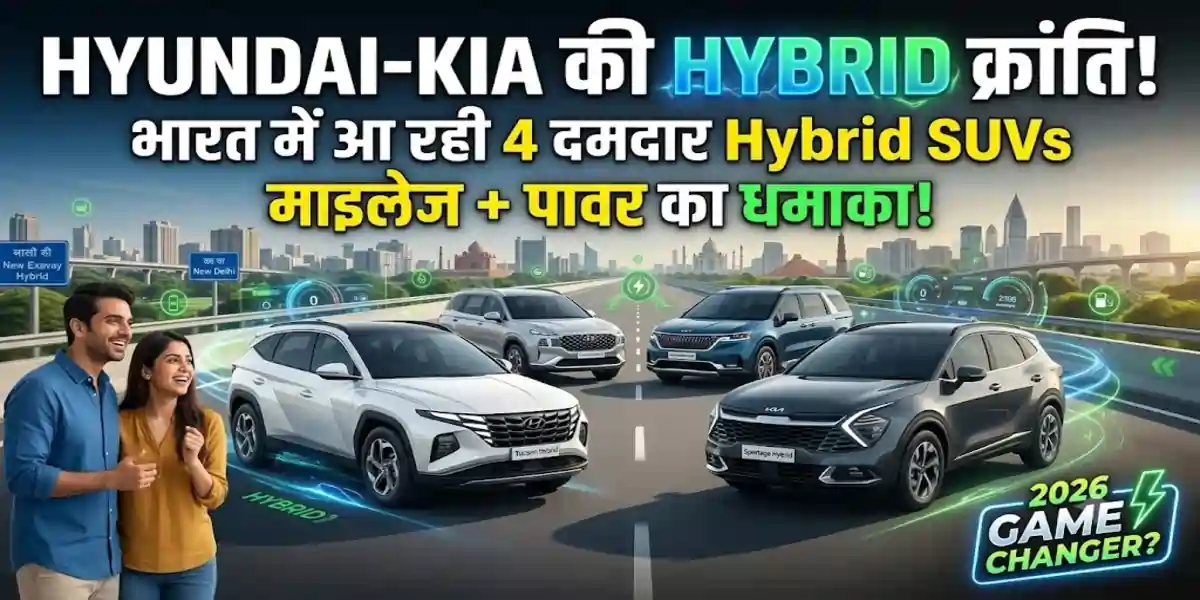
In a massive announcement that has sent shockwaves through the local Automobile market, South Korean siblings Hyundai and Kia have officially confirmed their roadmap to enter India’s competitive strong-hybrid segment. By the end of 2027, the duo will deploy four highly anticipated hybrid SUVs. This strategic expansion will not only include electrified iterations of their best-selling midsize models—the Creta and Seltos—but will also bring two premium, spacious three-row family SUVs designed to redefine efficiency in the premium segment.
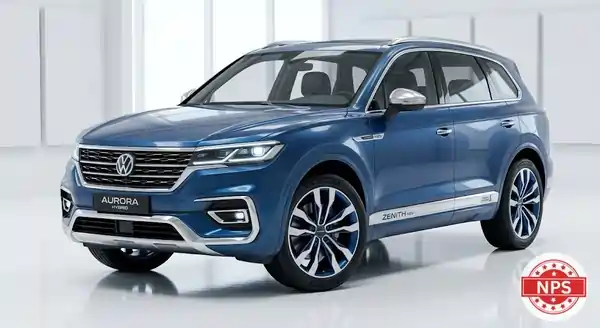
Setting the Stage: Why Hybrid is the Next Big Move for South Korean Giants
For years, Maruti Suzuki and Toyota have enjoyed a near-monopoly in the mass-market strong hybrid space with products like the Grand Vitara, Hyryder, and Innova Hycross. Hyundai and Kia, despite dominating the premium features and diesel space, lacked a direct answer to this high-efficiency powertrain.
The shift in strategy comes at a time when the Indian government is closely evaluating tax structures for eco-friendly vehicles and consumers are demanding high fuel economy without public charging anxieties. By developing localized hybrid solutions, Hyundai and Kia aim to protect their substantial Automobile market share in India while offering buyers a highly efficient, refined alternative to diesel engines, which are facing increasingly stringent emission norms across major metros.
Detailed Breakdown of the Confirmed 4 Hybrid SUVs
The South Korean carmakers are leaving no stone unturned, strategically targeting both the highly lucrative mid-size segment and the fast-growing premium 7-seater category. All four models are slated to complete their rollout by late 2027.
1. Next-Generation Hyundai Creta Hybrid
The Hyundai Creta remains the undisputed king of the mid-size segment. Introducing a strong hybrid variant will fundamentally alter the market dynamics. The hybrid version will arrive alongside the next-generation iteration of the SUV, promising unparalleled fuel efficiency in stop-and-go city traffic, a scenario where traditional petrol cars suffer significantly.
2. Next-Generation Kia Seltos Hybrid
Following closely on the heels of the Creta, Kia India will introduce a strong hybrid system for the next-generation Seltos. Known for its sporty design and cutting-edge cabin technology, the addition of an electrified powertrain will broaden the Seltos’ appeal to high-mileage buyers who traditionally leaned toward the brand’s CRDi diesel variants.
3. Hyundai’s New 7-Seater Premium SUV (Codenamed Ni1i)
Moving up the ladder, Hyundai is prepping a brand-new three-row hybrid SUV for large families. Codenamed Ni1i, this premium offering is expected to be structurally based on the long-wheelbase version of the acclaimed Hyundai Tucson currently on sale in China. This vehicle will bridge the gap between the Alcazar and the flagship Tucson in India.
4. Kia Sorento-Based Three-Row Hybrid (Codenamed MQ4i)
Kia’s weapon for the premium 7-seater space will be an international heavyweight adapted for local roads. Codenamed MQ4i, this SUV will be heavily based on the global Kia Sorento. It will directly enter the ring to challenge established players like the Mahindra XUV 7XO, the Tata Safari, and upcoming 7-seater hybrid models from rival camps.
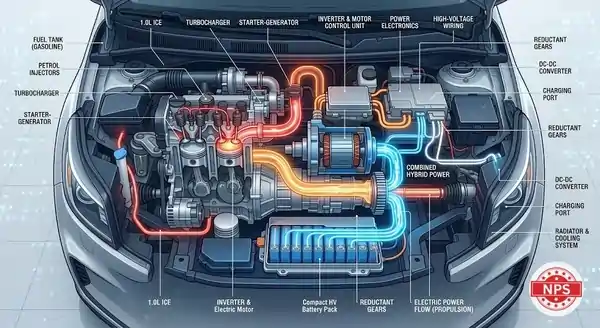
Decoding the Engine Mystery: 1.5L vs 1.2L Turbo Hybrid
While the product roadmap is explicitly clear, an intriguing debate is brewing within the Automobile engineering circles regarding the exact powertrain configuration that will make its way under the hood of these upcoming SUVs.
Initially, industry insiders predicted that Hyundai and Kia would opt for a hybrid setup built around their highly successful 1.5-litre naturally aspirated petrol engine. This approach would mirror global setups used by Japanese rivals. However, the latest automotive intelligence suggests a radically different path. Hyundai is reportedly hard at work developing an all-new, hybrid-ready 1.2-litre TGDi (Turbocharged Gasoline Direct Injection) petrol engine.
This downsized turbo-petrol hybrid unit is scheduled to make its global commercial debut in the upcoming international-spec Hyundai Bayon compact SUV. By pairing a high-torque turbo-petrol unit with an electric motor, the carmaker can deliver the immediate throttle response of a turbocharged engine alongside the exceptional low-speed fuel economy of an electric vehicle. This dual-character powertrain is expected to eventually serve both domestic Indian and global export requirements.
Expected Pricing and Positioning Strategy
Introducing advanced strong-hybrid hardware undoubtedly pushes manufacturing costs upward, a reality that will reflect in the eventual ex-showroom pricing of these premium SUVs.
- Creta & Seltos Hybrids: The strong-hybrid variants of these two popular mid-size SUVs are expected to command a premium of approximately Rs 2 lakh over their standard internal combustion engine (ICE) counterparts. This places them squarely against high-end variants of rival hybrid models.
- Hyundai Ni1i (7-Seater): Positioned as an executive family mover, this long-wheelbase model is estimated to retail somewhere in the ballpark of Rs 20 lakh to Rs 25 lakh.
- Kia Premium SUV (MQ4i/Sorento): Given its flagship positioning, global lineage, and larger footprint, this model is expected to start around the Rs 30 lakh mark (ex-showroom), making it a premium premium alternative to standard rugged ladder-frame off-roaders.
Future Roadmap: What Lies Beyond 2027?
The hybrid onslaught will not stop with these four core mid-size and premium products. The technology is designed to trickle down into more compact, mass-market segments as localized production scales up over time.
The upcoming Hyundai Bayon compact crossover will act as the global testbed for the new 1.2L TGDi hybrid setup. If local market reception proves highly positive, this technology is highly likely to make its way into smaller vehicles. Concurrently, Kia India is planning the next-generation launch of its highly successful Sonet subcompact SUV for late 2027. Following the comprehensive design overhauls and feature updates, the next-gen Sonet is widely expected to receive its own downsized hybrid powertrain variant around 2028 or 2029.

The Competitive Automobile Landscape in India
The second half of this decade is shaping up to be a true battleground for alternative powertrains. Hyundai and Kia’s entry will fundamentally shift the status quo, forcing other key Automobile manufacturers to rapidly innovate.
By the time the South Korean hybrids hit the tarmac in 2027, they will face stiff resistance not just from current market leaders Toyota and Maruti Suzuki, but also from upcoming alliances. Renault and Nissan are heavily invested in localizing their own international hybrid powertrains for India. Meanwhile, domestic giants Mahindra and Tata Motors continue to focus aggressively on pure electric vehicle line-ups and high-performance turbo-petrol units. This intense multi-front technological rivalry guarantees that the ultimate winner will be the Indian consumer, who will enjoy access to unparalleled choice, safety, and efficiency.
Conclusion: A Green Future Built on Practicality
Ultimately, the confirmation of four new hybrid SUVs from Hyundai and Kia underscores a vital realization within the global Automobile industry: the path to sustainable mobility is a multi-lane highway. Pure battery electric cars will continue to grow, but strong hybrids represent the immediate, consumer-ready answer for a nation with massive driving distances and developing infrastructure.
By combining their legendary knack for premium interior design, advanced feature suites, and robust ride quality with cutting-edge electrified turbo powertrains, the South Korean brands are positioning themselves to dominate the next phase of India’s automotive evolution. It is a bold, calculated gamble that will undoubtedly set new benchmarks for fuel efficiency and performance on Indian roads.
What are your thoughts on Hyundai and Kia’s big hybrid push for the Indian market? Would you choose a strong-hybrid Creta or Seltos over a pure EV or standard petrol variant? Let us know your perspective in the comments section below, and share this breaking Automobile update with your car enthusiast friends!
Frequently Asked Questions (FAQs)
Q1: When will the new Hyundai and Kia hybrid SUVs launch in India? All four confirmed hybrid models—including the electrified Creta, Seltos, and the two premium 7-seater models—are scheduled to make their market debuts by the end of 2027.
Q2: What is the main difference between a mild hybrid and the strong hybrid tech expected in these SUVs? Mild hybrids use a tiny electric motor solely to assist the engine during acceleration and handle start-stop functions. Strong hybrids, like the ones coming from Hyundai and Kia, can drive purely on electric power at low speeds, resulting in vastly superior city fuel economy.
Q3: Why are Hyundai and Kia developing a new 1.2L turbo petrol engine for hybrids instead of using the 1.5L engine? A downsized 1.2L TGDi turbo petrol engine offers structural efficiency and fits better under local tax classifications while delivering excellent performance when paired with an electric motor.
Q4: Will these hybrid SUVs be more expensive than standard petrol or diesel variants? Yes, due to the inclusion of a specialized electric motor, battery pack, and complex power control units, the hybrid variants are expected to carry a premium of around Rs 2 lakh over traditional ICE variants.
Q5: Can these upcoming strong hybrid vehicles be charged using an external plug? No, these will be self-charging hybrid vehicles. The internal battery pack is automatically replenished through regenerative braking and by utilizing the onboard petrol engine as a generator while driving.