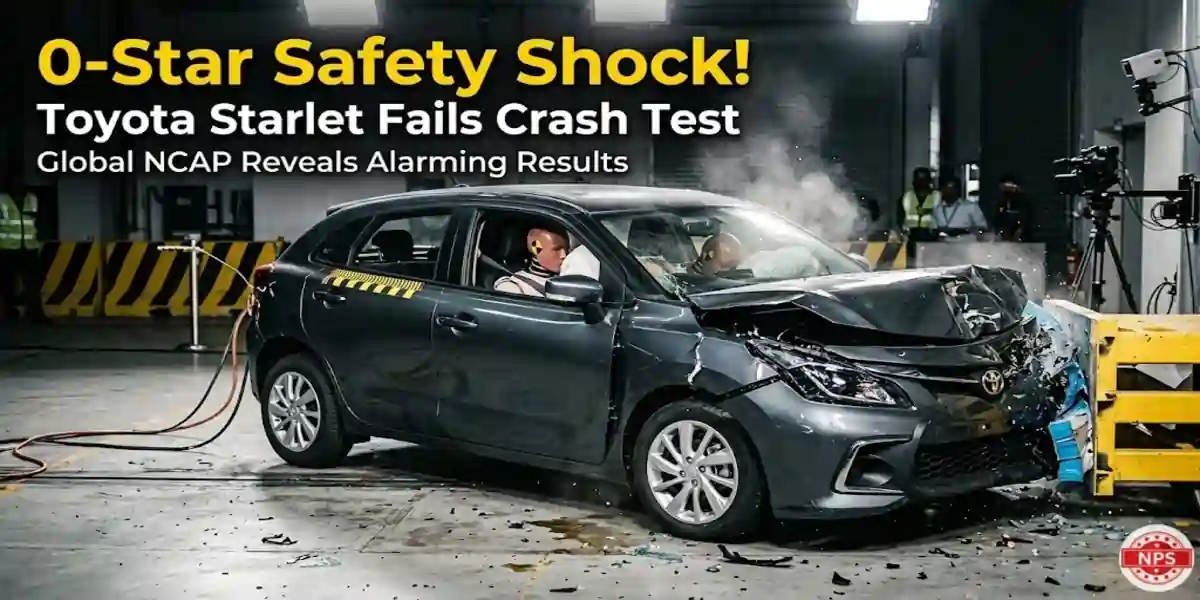
Vehicle safety has become a paramount deciding factor for consumers looking to invest in a new vehicle. However, a recent announcement has sent shockwaves through the global automobile market. The South African-spec Toyota Starlet premium hatchback was recently subjected to the rigorous crash testing protocols of the Global New Car Assessment Programme (Global NCAP). In a surprising turn of events, the hatchback returned a deeply disappointing 0-star safety rating.
For the uninitiated, this news hits incredibly close to home for Indian buyers. The Toyota Starlet is not a completely independent model; it is essentially the export twin of the Toyota Glanza sold across India. Manufactured right here in India and shipped to international markets like South Africa, the vehicle’s poor performance has raised serious questions about structural differences, regional feature deletions, and safety prioritization across different borders.
In this comprehensive analysis, we will deconstruct the engineering failures highlighted by the test, compare the export model with its Indian counterpart, and examine what this means for the future of compact hatchbacks in the highly competitive global automobile ecosystem.
1. Understanding the Platform: Toyota Starlet, Glanza, and the Maruti Baleno Alliance
To fully grasp the gravity of this 0-star Global NCAP crash test rating, one must understand the cross-badging strategies that dominate the modern automobile sector. The Toyota Starlet is born out of the global Toyota-Suzuki alliance. In the Indian domestic market, Maruti Suzuki manufactures the Baleno, which is then shared with Toyota to be sold as the Glanza. For export markets like South Africa, the vehicle undergoes a name change to become the Toyota Starlet.
The Regional Specification Divergence
While the platform and design architecture remain identical across these nameplates, the mechanical and safety specifications vary drastically depending on the target market.
- The Powertrain: Unlike the India-spec Glanza, which features a fuel-efficient 1.2-liter K-Series petrol engine, the South African Toyota Starlet is driven by a larger, more powerful 1.5-liter naturally aspirated petrol engine delivering 105PS of power.
- The Safety Benchmark Contrast: This zero-star result by Global NCAP has created immense confusion because the underlying platform—the Maruti Suzuki Baleno—recently secured an impressive 4-star safety rating under the newly established Bharat NCAP (B-NCAP) crash test protocols in India.
This vast disparity highlights how variant configurations, weight distributions, and targeted safety equipment completely alter a car’s crash survival capabilities.
2. Adult Occupant Protection Fails Miserably: Breaking Down the 0/34 Score
The most critical blow to the Toyota Starlet’s reputation came in the Adult Occupant Protection (AOP) category. Out of a maximum score of 34 points, the hatchback managed to secure an absolute zero (0 points).
Toyota Starlet Adult Occupant Protection: 0 / 34 Points (0 Stars)
When a car scores zero points for adult safety, it typically points toward catastrophic structural weaknesses or a high probability of life-threatening injuries to critical body regions during an accident. Global NCAP’s detailed engineering data revealed exactly where the vehicle fell short during high-speed impact simulations.
Frontal Offset Deformable Barrier Test Performance
The frontal offset test simulates a head-on collision with another vehicle of similar weight at a speed of 64 km/h. During this test, the Starlet displayed highly erratic protection levels for the front row passengers.
- The Good News: The vehicle managed to offer ‘Good’ protection for the driver’s neck and left tibia, ensuring that lower extremities on one side remained relatively safe. The front passenger also received ‘Good’ safety marks for the head and neck.
- The Adequate Areas: Protection for the driver’s head, chest, and right tibia was rated as ‘Adequate’. Similarly, the front passenger’s chest and tibia protection levels hovered within the adequate range.
- The Dangerous Deficiencies: The real concern began with the protection of the thighs (femur region). The hatchback only managed to provide ‘Marginal’ protection for both the driver and co-driver’s thighs, risking severe bone fractures. Furthermore, the driver’s feet protection was deemed ‘Marginal’ due to excessive footwell deformation.
Critical Structural Finding: Global NCAP officially rated the integrated bodyshell structure of the Toyota Starlet as unstable. An unstable structure means the frame cannot withstand further loads or higher speeds without collapsing inward into the passenger cabin, making it a critical red flag for any automobile engineer.
Side Movable Deformable Barrier Test Failures
During the side impact test, where a movable barrier rams into the side of the vehicle at 50 km/h, the Starlet’s lack of advanced cabin protection became obvious.
While it offered ‘Good’ protection for the pelvic area and ‘Adequate’ protection for the abdomen, it provided ‘Poor’ protection for both the head and chest. In modern crash testing protocols, a ‘Poor’ rating on the chest or head in a side-impact test triggers an immediate drop in stars, often leading to a zero-star outcome regardless of how well the car performs in other areas.
Additionally, the highly demanding side pole impact test could not even be conducted on the Toyota Starlet. This test requires the vehicle to have robust side head protection gear, but because this specific export variant lacked side curtain airbags, Global NCAP bypassed the test entirely, further cementing its lowest rating.
3. Child Occupant Protection: A Mixed but Slightly Better Outcome
While adult protection was a total disaster, the Toyota Starlet managed to salvage some dignity in the Child Occupant Protection (COP) category, walking away with a 3-star rating after securing 29.33 out of a maximum of 49 points.
Dummy Performance Breakdown
The test utilized child dummies representing an 18-month-old infant and a 3-year-old toddler to evaluate how well child restraint systems function inside the cabin during high-G deceleration events.
- The 18-Month-Old Dummy: The vehicle performed exceptionally well here, scoring 6.71 out of 8 points in the frontal crash simulation and securing a perfect 4 out of 4 points during the side-impact crash test.
- The 3-Year-Old Dummy: Performance dropped noticeably for the older child dummy. The Starlet scored a lowly 2.81 out of 8 points in the frontal test and a highly concerning 0 out of 4 points in the side crash analysis. This indicates that as children grow larger, the existing cabin architecture fails to shield them effectively from lateral forces.
Child Restraint System (CRS) Installation
On the positive side, the vehicle’s hardware for mounting child seats proved to be user-friendly and well-engineered. In the Child Restraint System installation assessment, the Starlet scored a strong 10.81 out of 12 points. However, due to missing safety labels, limited unassisted compatibility, and design quirks, it only secured 5 out of a maximum of 13 points in the overall vehicle assessment score.
4. The Airbag Conundrum: Comparing Export vs. Indian Domestic Specifications
One of the biggest talking points across the global automobile community following this test is the massive disparity in standard safety equipment between identical-looking cars sold in different countries.
The Toyota Starlet variant tested by Global NCAP was equipped with basic safety features meant to fulfill baseline regulatory requirements in South Africa:
- Dual front airbags (Driver and Co-driver)
- Electronic Stability Control (ESC)
- Seatbelt reminders for all seating positions
- ISOFIX child seat anchor points
- Front seatbelt pretensioners
In stark contrast, the India-spec Toyota Glanza has significantly leveled up its safety game. To comply with shifting Indian consumer trends and stringent government proposals, Toyota India offers six airbags as standard across the vast majority of the Glanza’s variants. The presence of side torso and curtain airbags is precisely what shields occupants’ heads and chests during dangerous side-swipe accidents—the exact area where the export version collapsed into a ‘Poor’ rating.
5. Why Do Bharat NCAP and Global NCAP Ratings Show Such Disparities?
Many car buyers are left scratching their heads when they see a platform get 4 stars in India under Bharat NCAP, yet drop to 0 stars under Global NCAP. To understand this anomaly, we have to look closely at the underlying testing matrices.
1. Assessment Rules and Automatic Penalties
Global NCAP updated its testing protocols to become far harsher. Under the current regime, if a vehicle shows ‘Poor’ protection for a vital body part (like the chest or head) in a core test, or if its bodyshell is declared fundamentally unstable, the entire score is heavily penalized. Even if the car has excellent brakes, seatbelt reminders, and electronic safety aids, structural failure instantly tanks the score to zero stars.
2. Differing Base Variants
Bharat NCAP tests models specifically configured for the Indian market, incorporating the standard safety equipment mandated or voluntarily offered by manufacturers within the country (such as 6 airbags and reinforced localized pillars). Export batches often target value-driven economies where base trims are stripped of side and curtain airbags to keep retail prices incredibly low.
6. What This Means for the Future of Compact Hatchback Safety
This zero-star rating will likely force a massive recalculation among manufacturers exporting vehicles from India. For decades, the compact hatchback segment focused purely on fuel efficiency, low maintenance costs, and cabin space. However, as global safety bodies tighten their metrics, brands can no longer rely on brand equity alone to move metal.
Car manufacturers are realizing that treating safety as an optional luxury rather than a standard necessity can completely destroy a model’s global marketability overnight. Consumers are paying closer attention than ever to crash test sheets, pushing carmakers to democratize advanced safety shielding across all global variants.
Conclusion: A Wake-Up Call for Global Product Planning
In conclusion, the 0-star Global NCAP crash test rating for the Toyota Starlet serves as a stark reminder that not all cars are created equal, even if they share the exact same silhouette and factory assembly lines. While the platform excels under localized Indian testing frameworks due to higher standard airbag counts and specific trim adjustments, the bare-bones export model simply could not withstand Global NCAP’s uncompromising assessment matrix.
For the automobile industry to truly mature, safety engineering must transcend regional boundaries. Buyers across all corners of the globe deserve identical structural integrity and lifesaver passive safety kits. It remains to be seen how Toyota and Suzuki will respond to this engineering setback, but a swift mid-cycle update introducing standard side curtain airbags to export batches seems like the only logical way forward.
What are your thoughts on this shocking crash test result? Would a 0-star rating deter you from buying an export-spec vehicle, or do you believe local feature sets tell a different story? Let us know your perspective in the comments section below!
Frequently Asked Questions (FAQs)
Q1. Why did the Toyota Starlet score 0 stars when the Maruti Baleno got 4 stars in Bharat NCAP?
The variant of the Toyota Starlet tested by Global NCAP lacked side curtain and torso airbags, leading to a ‘Poor’ protection score for the head and chest during side impacts. Bharat NCAP evaluates Indian-spec models that come equipped with comprehensive standard safety equipment, including 6 airbags, which vastly improves side-impact deflection scores.
Q2. Is the body structure of the Toyota Starlet different from the Toyota Glanza sold in India?
While both vehicles are built on the same Suzuki HEARTECT platform and manufactured in India, the overall safety performance depends on the localized structural reinforcements and the number of airbags present to cushion occupants when the frame deforms. Global NCAP officially rated the Starlet’s bodyshell as ‘unstable’.
Q3. What engine powers the export-spec Toyota Starlet?
Unlike the Indian-spec Glanza which utilizes a 1.2-liter petrol motor, the South African-spec Toyota Starlet is powered by a more robust 1.5-liter naturally aspirated petrol engine that puts out 105PS of peak power.
Q4. Can a car with Electronic Stability Control (ESC) and dual airbags still score 0 stars?
Yes. Active electronic safety features like ESC can help a driver avoid a skid, but they do nothing to absorb physical impact forces once a crash occurs. If the physical structure of the car allows excessive cabin intrusion or scores a ‘Poor’ safety rating on critical anatomical zones like the head or chest, the vehicle is automatically dropped to a 0-star level under modern NCAP rules.
Q5. Will Toyota update the safety features of the Starlet after this test result?
While no official structural or equipment updates have been confirmed by the manufacturer immediately following the test, automotive brands typically roll out mid-lifecycle updates or adjust standard safety equipment lists globally to protect their market reputation and satisfy consumer safety watchdogs.