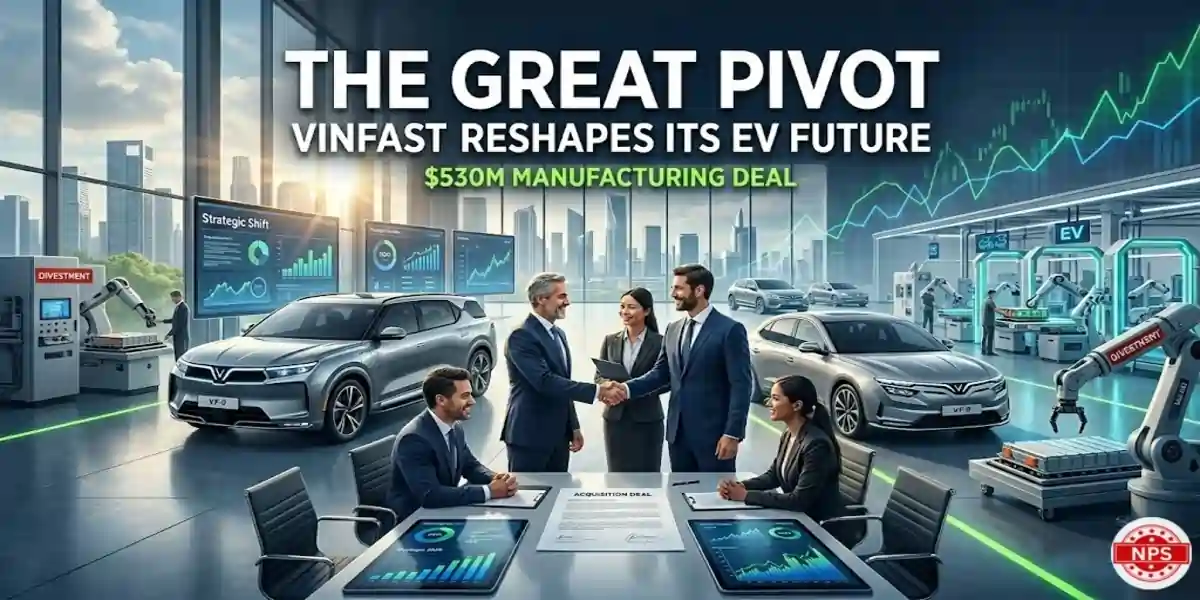
The global Automobile industry is currently witnessing a tectonic shift, not just in the way vehicles are powered, but in how companies are structured. In a move that has sent ripples through the electric vehicle (EV) sector, VinFast, the Vietnamese EV pioneer, has announced a massive restructuring of its manufacturing business. Valued at approximately USD 530 million (VND 13.3 trillion), this divestment is more than just a financial transaction; it is a fundamental reimagining of what it means to be a modern car manufacturer.
By separating its production arm from its core brand operations, VinFast is joining an elite group of tech-forward companies that prioritize research, branding, and customer experience over the heavy, debt-laden world of factory ownership. In this deep dive, we explore the mechanics of the deal, the birth of the new entity VFTP, and what this means for the future of the Automobile landscape.
1. Deconstructing the $530 Million Divestment
At the heart of this announcement is a strategic “divorce” between the brand and the hammers and anvils that build the cars. VinFast is carving out its manufacturing operations in Vietnam into a newly formed entity called VinFast Trading and Production JSC (VFTP).
What exactly is moving to VFTP?
The restructuring isn’t just a paper shuffle. It involves the transfer of significant physical and financial assets:
- The Hai Phong Factory: The crown jewel of VinFast’s production, known for its high level of automation.
- The Ha Tinh Plant: A vital cog in the manufacturing wheel, focused on supporting current and future models.
- Production Liabilities: In a bold move, VFTP will assume roughly VND 182 trillion (USD 7.3 billion) in liabilities associated with manufacturing operations.
This transfer of debt is perhaps the most critical aspect for investors. By moving this burden to a separate entity, the core VinFast business becomes a leaner, more agile player in the competitive Automobile market.
2. Who Are the New Owners of the Manufacturing Arm?
VinFast isn’t simply selling its factories to a stranger. The deal keeps the production within a familiar ecosystem. VFTP is being transferred to an investor group led by Future Investment and Development Research JSC.
Interestingly, the group includes participation from Pham Nhat Vuong, the visionary founder of VinFast and chairman of Vingroup. This ensures that while the manufacturing arm is legally and financially separate, it remains aligned with the overarching vision of the brand. This “strategic distance” allows the manufacturing unit to seek its own efficiency while continuing to serve as the primary builder for VinFast’s growing fleet of EVs.
3. Embracing the “Asset-Light” Business Model
Why would an ambitious EV maker give up its factories? To understand this, we have to look at the broader Automobile and tech trends. The “asset-light” model is becoming the gold standard for companies that want to scale rapidly without being crushed by the overhead of heavy industry.
“In the modern era, being a car company is increasingly about being a software company. By moving away from direct ownership of expensive manufacturing assets, we can focus on what truly defines the brand: the technology inside the car and the experience of the driver.”
The Benefits of Going Asset-Light:
- Operational Flexibility: Without the day-to-day burden of managing massive labor forces and factory maintenance, VinFast can pivot quickly to new technologies.
- Efficient Capital Allocation: Funds that would have gone into painting shop upgrades or robotic maintenance can now be funneled into R&D, autonomous driving systems, and battery chemistry.
- Faster Path to Profitability: By offloading billions in manufacturing debt, the company’s balance sheet looks significantly healthier, clearing the way for a projected turn toward profitability starting in 2027.
4. Comparing the Core VinFast vs. VFTP
Following this restructuring, the two entities will have distinct roles within the Automobile ecosystem.
| Feature | Core VinFast Business | VFTP (The New Entity) |
| Primary Focus | R&D, Software, Product Engineering | Vehicle Production & Assembly |
| Market Strategy | Branding, Sales, Marketing | Contract Manufacturing Potential |
| Asset Type | Intellectual Property, Software, Brand | Factories, Robots, Physical Infrastructure |
| Financial Goal | High-margin tech and service revenue | Volume-based manufacturing efficiency |
5. The Future of VFTP: The “Foxconn of Cars”?
One of the most intriguing possibilities mentioned in the restructuring plan is that VFTP will not be exclusive to VinFast. While its primary job remains building VinFast EVs, the entity is now positioned to explore contract manufacturing and assembly partnerships with other companies.
Imagine a world where a new EV startup in Europe or North America wants to enter the Automobile market but doesn’t have $2 billion to build a factory. They could potentially hire VFTP to build their cars in Vietnam. This turns the manufacturing arm from a “cost center” for VinFast into a “profit center” that serves the entire global industry.
6. What This Means for the Everyday Automobile Customer
Whenever a major corporation “restructures,” customers naturally get nervous. Will my warranty be honored? Will the quality of the cars change? Will spare parts become hard to find?
VinFast has been proactive in addressing these concerns. The company clarified that the restructuring is purely a financial and organizational move.
- Production Quality: The factories in Hai Phong and Ha Tinh will continue to produce vehicles under the same stringent quality standards.
- Service & Sales: All customer-facing operations, including showrooms, service centers, and mobile service units, remain under the core VinFast brand.
- After-Sales Support: Warranties and software updates will continue as usual. In fact, with the core business focusing more on customer experience, users might actually see an improvement in service speed and software stability.
7. Global Context: The EV Debt Challenge
The global Automobile market is currently a graveyard of ambitious startups that failed because they couldn’t balance the cost of building cars with the cost of developing tech. From Rivian to Lucid, the struggle is real.
VinFast’s decision to move $7.3 billion in liabilities to VFTP is a masterstroke in financial engineering. It acknowledges a harsh truth: building cars is expensive, and high interest rates make carrying manufacturing debt a heavy burden. By insulating the brand from this debt, VinFast protects its ability to raise capital and innovate, ensuring it stays relevant in an Automobile world dominated by giants like Tesla and BYD.
8. Strategic Roadmap to 2027 Profitability
The end goal of this $530 million deal is clear: Profitability. VinFast has set its sights on 2027 as the year it moves into the black. To get there, the company is focusing on several key pillars:
- Technological Leadership: Investing heavily in “Integrated Infotainment” and AI-driven safety features.
- Global Expansion: Scaling up presence in the US, India, and Southeast Asian markets.
- Battery Innovation: Developing proprietary battery technologies to reduce reliance on external suppliers.
This restructuring provides the financial “breathing room” necessary to execute this plan without the constant pressure of manufacturing-related debt service.
Conclusion: A Leaner, Meaner VinFast
In conclusion, VinFast’s decision to divest its manufacturing unit into VFTP is a bold bet on the future of the Automobile industry. It signals a move away from traditional industrialism toward a tech-centric business model. By offloading $7.3 billion in debt and focusing on high-value operations like R&D and marketing, VinFast is positioning itself as a nimble competitor capable of out-innovating the old guard.
The deal valued at $530 million is not an exit from manufacturing, but a professionalization of it. As VFTP opens its doors to potential contract manufacturing, we might be looking at the birth of a new manufacturing giant in Southeast Asia. For VinFast, the path to 2027 is now clearer, leaner, and much more exciting.
Do you think the “asset-light” model is the only way for new EV companies to survive today? Or is there still value in owning the factory floor? Let us know your thoughts in the comments below!
Frequently Asked Questions (FAQs)
Q1: Is VinFast still making its own cars?
Yes. While the manufacturing arm is now a separate entity called VFTP, it is owned by an investor group that includes VinFast’s founder. The cars will still be designed by VinFast and built to their specific quality standards in the same factories.
Q2: Why did VinFast move $7.3 billion in debt to VFTP?
This is a financial strategy to improve the core company’s capital efficiency. By moving manufacturing-related liabilities to the production entity, the core brand can focus its financial resources on R&D, marketing, and expansion, accelerating the path to profitability in the Automobile market.
Q3: Will this affect the price of VinFast EVs?
There is no indication that this will change vehicle pricing. In the long run, if VFTP achieves higher efficiency or takes on contract work for other brands, it could potentially lower production costs through economies of scale.
Q4: What is an “asset-light” business model in the car industry?
It involves a company focusing on high-value intangible assets like software, design, and branding, while outsourcing or separating the heavy physical assets like factories and machinery. This model is common in the tech industry (e.g., Apple doesn’t own the factories that make iPhones).
Q5: When does VinFast expect to become profitable?
Following this restructuring, VinFast expects to move toward profitability starting from 2027 onward.
Expert Guide Question: Given the rise of contract manufacturing in other tech sectors, do you believe we will see a “Foxconn of the Automobile world” dominate the industry by 2030? Share your perspective with us.